English communication training for technical teams
Knowing the answer is not the same as being heard.
We help engineers and technical teams in Asia explain their ideas clearly in English meetings with global colleagues. We find where their message is lost, train them on the situations they face at work, then measure what changed.
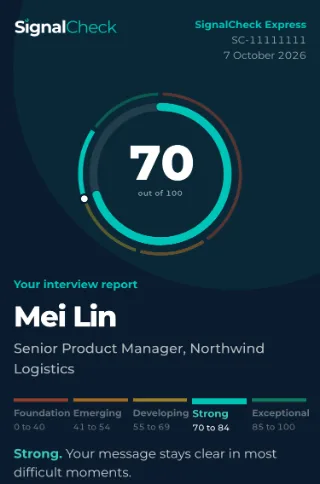
A SignalCheckSample
61
Developing
Sample scores. A trained reviewer reads every report before it is delivered. View a sample personal report
Professionals who have worked with the methodology have worked at organisations including
Company names show the employers of individual clients. They do not imply a corporate engagement or endorsement.
Four things a team leader can see
Your team may already work well in English. The cost shows in the extra work: a decision explained twice, an agreement checked by message, a concern that was not understood the first time.
You explain it for them
Your engineer can explain the design to you in two minutes. When a global colleague questions it in English, the reason comes out long, so you step in and explain it again. When nobody does, the decision goes the other way, and the work is built again.
Concerns arrive after the decision
They can see the requirement is incomplete. What head office hears is that there may be some difficulty, so the plan does not change. The concern comes back after the work has started, as rework, overtime and missed dates.
The explanation continues after the meeting
The recommendation that was clear in the document is hard to follow in the call, and the call ends without a clear next step. Messages and a second meeting are needed to agree what was meant, across time zones.
Sharp one to one, quiet in front of twenty
A senior manager asks something they did not expect. They sound less certain than they are. In the room where it mattered most, their expertise was overlooked.
The expertise is already there. It does not always survive a live meeting in English. These moments can be assessed, and they can be trained. Your strongest people may never tell you: they work around it quietly.
Assess, train, then measure again
Assess
Each person takes a 15-minute pressure interview with the Interviewer, at a time that suits them, then a 15-minute conversation with a practitioner in the same week. We see how they explain, respond and raise concerns when the questions are hard. They receive a written report on five areas: clarity, structure, confidence under pressure, thinking and responding quickly, and natural delivery.
Train
We train on what the assessment found, using the team's real meetings and presentations. Practitioners teach the techniques. AI drills, built on our method, give each person practice between sessions. The people who need it most also get one-to-one help.
Measure again
At the end, each person takes a second assessment: different situations, the same difficulty. Each person sees their own change. You see the team's.
We call the assessment a SignalCheck, and the training SignalResponse. See how it works.
What working with us looks like
An example for a team of twelve. We agree the plan for your team in writing before anything starts.
Before we start
A free 20-minute call. We agree the team, the dates and the privacy rules in writing.
Month 1: the assessment
Each person takes the 15-minute pressure interview at a time that suits them, then a 15-minute conversation with a practitioner in the same week, and receives a private report within five working days. At the end of the month, you receive the team pattern and a short written summary for each person, with no scores. We go through them with you.
Months 2 to 4: the training
One 60-minute live session a month with a practitioner, on your team's real situations, in groups of up to six. Two 10-minute AI drills a week between sessions. A 30-minute one-to-one each month for the people the results show will gain most.
End of month 4: measure again
Each person takes a second assessment, on different situations at the same difficulty. You see what improved and what still needs work, for the team as a whole. Then we decide together what comes next.
- Time for each person: 30 minutes at the start, in two parts, about two and a half hours a month during the training (three hours for the people who have one-to-one sessions), and 30 minutes at the end.
- You can also start with the assessment month on its own.
What our feedback looks like
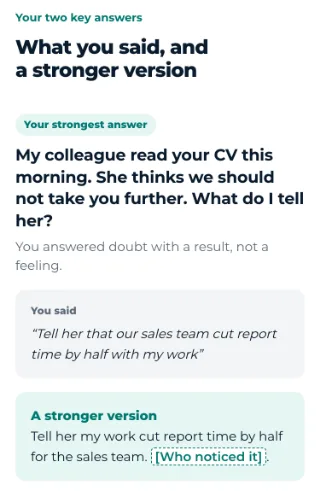
Scores show where the problem is. The report also shows what we saw, why it matters and what to practise.
- The moment
- In a design review, a director asks an engineer: “Why not keep the old service?”
- What we saw
- She talks about the background for 50 seconds before she gives her reason. After 30 seconds, the director starts to ask another question.
- Why it matters
- Her reason came 50 seconds in. By then the director had moved to the next question, and it was never discussed.
- What we practise
- Give the answer first, in one sentence. Then one reason and one example. We practise it with interruptions, using questions from her next real design review.
- Area
- Structure, Developing.
What you receive
Two outputs, and a line between them.
The organisation receives the Team Signal Map
One combined pattern for the group, with names and individual scores removed.
The person receives their private report
Five scored dimensions, written interpretation and what to work on first. A trained reviewer checks it before delivery.
The organisation receives the map, not the individual reports behind it.
Training for a team, or for one person
For a team or organisation
SignalResponse Teams
A quarterly development cycle for teams that work across regions. It combines human-led team sessions, private AI practice, targeted 1:1 support, manager and meeting work, and a second SignalCheck.
See SignalResponse Teams
For yourself
SignalResponse 1:1
Eight hours of private 1:1 development built from your SignalCheck report. The work focuses on your measured patterns and the situations that matter in your role.
See how SignalResponse worksData and confidentiality
Who sees what
This is why people agree to be measured at all.
The individual
- Private report
- Full personal score
- Private development
The organisation
- Team-level pattern
- A short written summary for each person
- No individual scores
- Agreed team evidence
No individual score goes to a manager. Not on request, not in the debrief, not ever.
The four commitments: each person owns their score. A leader receives the map, not a ranking. Everyone is told before they join that their leader receives a short written summary about them, with no scores, and that they get a copy. A trained reviewer reads every report. Full rules: data and confidentiality.
Who is behind SignalCheck

SignalCheck was built by Michael Gunn after sixteen years working one to one with professionals across APAC. The method came from watching excellent people lose decisions in English that they would have won in their first language. Each SignalCheck is a 15-minute pressure interview with the SignalCheck Interviewer, then 15 minutes with a practitioner. A trained person reviews every report before it is delivered.
Where do you want to start?
Two routes, one method. Pick the one that describes your situation.
For a team or organisation
Twenty minutes on your team: what the sessions involve, what each person receives, and how the results turn into development. Bring a real situation and we will show you how the method works on it. If it is not the right fit, we will say so.
Book a team call
For yourself
Twenty minutes with an assessor, covering two of your five dimensions, talked through in the session.
Book a free SignalScan